

New Landscape in the Protection of Industrial Property Assets in Argentina
BY PEDRO BREUER MORENO

Key Takeaways:
- Chemical and pharmaceutical patents regain full protection following the repeal of the 2012 joint resolution, which had restricted their patentability for over a decade.
- Biotechnology patents regain full protection following the repeal of INPI Resolution No. 283/15.
- Accelerated patent prosecution can now be requested at any stage of the proceedings, and Argentina’s accession to the PCT is closer than ever.
- INPI no longer raises objections against marks similar to prior registrations: active monitoring and timely opposition are now the major effective defense against conflicting new filings.
- 55% of trademark applications are filed without specialized counsel, increasing the risk of conflicts and reinforcing the value of professional advice.
- The Milei administration’s trade liberalization policy has significantly increased the influx of imported goods, including counterfeits and dupes, requiring a protection strategy that combines trademark monitoring, customs enforcement mechanisms, and unfair competition rules.
Introduction
Since early 2025, and with greater momentum throughout 2026, a series of amendments to the regulations currently in force in Argentina have been formalized, aimed at: (a) streamlining the prosecution of trademark and patent applications, and (b) strengthening industrial property rights in line with international standards and the commitments undertaken by Argentina.
These structural changes have coincided with the growing adoption of technology across Argentine society, which has driven a sharp increase in trademark filings by individuals and given rise to new forms of infringement.
The combination of structural reform and technological adoption presents a new landscape for both domestic and international companies to consider best practices and tools for protecting their industrial property assets in Argentina.
Adequate Protection for Patent Rights in Argentina
(a) Chemical and Pharmaceutical Patents
Effective March 18, 2026, the Ministry of Health, the Ministry of Economy, and the National Institute of Industrial Property (INPI) signed a new Joint Resolution (No. 1/2026) repealing the one issued in 2012 (Nos. 118/2012, 546/2012, and 107/2012), which had been responsible for the rejection or restriction of patentability of the following inventions:
Pharmaceutical compositions and formulations, Markush formulae, polymorphs, pseudo-polymorphs, pro-drugs, metabolites, selection inventions, enantiomers, combinations, salts, esters and other derivatives of known substances, dosage forms, and second medical uses.
These inventions should now be considered patentable in accordance with the Patent Law, the National Constitution, and the TRIPS Agreement.
This development entails significant changes in the prosecution and outcome of patent applications in the chemical and pharmaceutical fields.
The practical impact of the regulations in force between 2012 and 2025 is evident. Through that period, chemical and pharmaceutical patent filings in Argentina declined by 35% compared to twelve years prior:
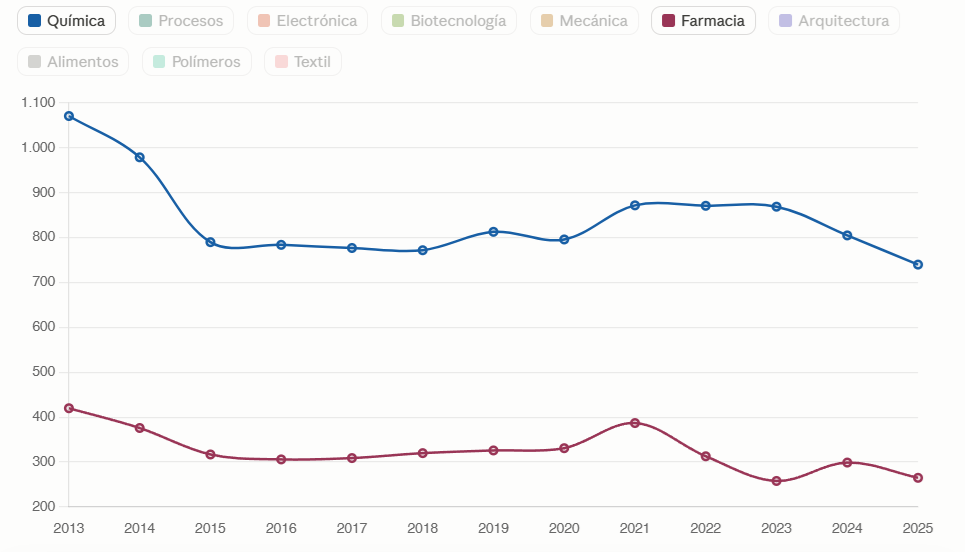
This shift is expected to reverse the downward trend, which will require closer attention to registration in order to adequately protect inventions and prevent infringement.
(b) Biotechnology Patents
On June 19, 2026, the National Institute of Industrial Property issued Resolution 197/2026, repealing Resolution 283/2015, which had tightened the 2003 Patentability Guidelines with respect to living matter, a restrictive stance that had limited access to protection for biotechnological inventions.
The primary effect of this repeal is that the term “isolated” will no longer be required when claiming subject matter such as an antibody, a genetic sequence, an amino acid sequence, or a cell.
Under the repealed measure, INPI required the insertion of the term “isolated” in such claims to prevent applicants from seeking protection over the organism that contains, for example, the antibody, genetic sequence, amino acid sequence, or cell — since under Argentine law, plants and animals, whether modified or unmodified, are not patentable. In practice, however, the mandatory use of the term “isolated” adversely affected the industrial applicability of such claims. This is no longer an issue following the repeal.
(c) Accelerated Patent Prosecution at Any Stage of the Proceedings
Through Resolution 142/2026 of May 13, INPI relaxed the requirements for accelerated patent prosecution. The mechanism allows an application already granted abroad to be resolved expeditiously in Argentina, with its novelty, inventive step, and industrial applicability recognized directly, without the need for a prior art search.
The key change introduced by this reform: this benefit may now be requested at any stage of the proceedings, and not only prior to substantive examination, as the previous rules required.
(d) PCT in sight
On May 12, the Milei administration secured a majority committee report in favor of the Patent Cooperation Treaty. This was the required formal preliminary step enabling the treaty to be brought before the National Congress for consideration.
Argentina’s accession to the PCT is a long-overdue commitment that would strengthen patent protection for domestic inventors and facilitate the filing and prosecution of foreign patents in Argentina. The treaty’s expected approval this year has been driven by the trade agreements recently concluded with the United States and the European Union, both of which include accession to the PCT as a requirement.
Trademark monitoring was already critically important. It is now indispensable.
(a) TMO No Longer Raises Objections on Relative Grounds
Through Resolution 583/2025 of December 2025, the National Institute of Industrial Property amended the trademark registration procedure with the stated aim of “simplifying processes, reducing timelines, and providing greater predictability for entrepreneurs and businesses.”
In practice, for new trademark applications, as of March of this year, the registrability examination is limited to absolute grounds for refusal and matters related to public policy. Relative grounds, such as similarity to prior marks or other private-interest considerations, will only be assessed upon request by an interested party, through the opposition mechanism.
In plain terms: if a potentially confusing mark is filed and no opposition is lodged, INPI will not object to its registration.
(b) The Significant Increase in Trademark Applications Filed by Individuals
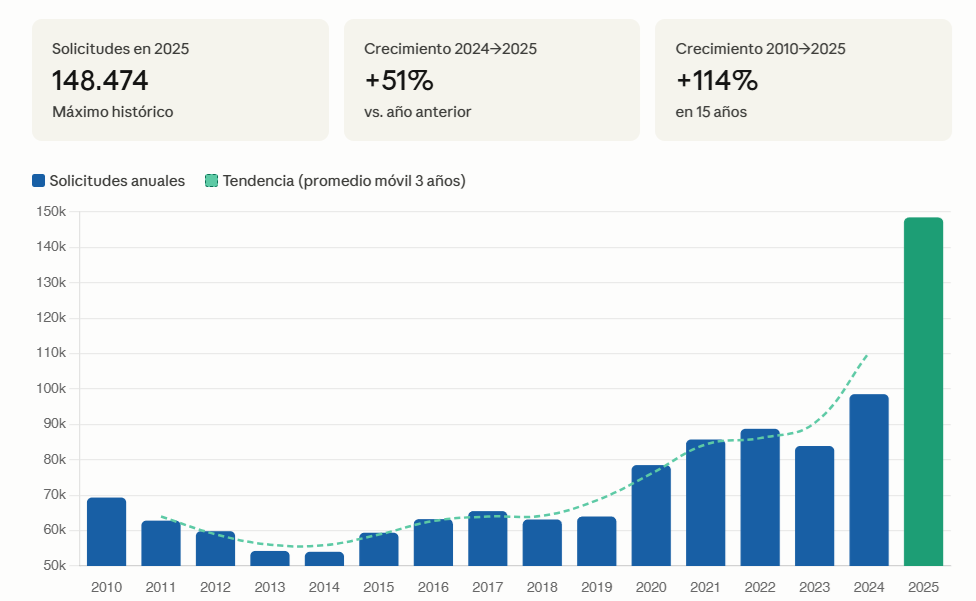
As the chart illustrates, Argentina has experienced significant growth in new trademark filings since 2020. This trend can be attributed to low administrative costs, procedural simplification (including digitalization and the incorporation of TM Class for classification purposes), and, over the past eighteen months, the use of AI tools to guide applicants through the process: any of the popular LLMs used in retail contexts can walk a user through the entire filing procedure from start to finish.
A particularly notable development is the sharp rise in filings by unrepresented parties: companies or individuals proceeding without the assistance of a trademark agent or specialized attorney. In 2025, approximately 50% of new trademark applications were filed without an agent. In 2026, the trend is accelerating: that figure has risen to 55%.
For context, between 2010 and 2020 the share of applications filed by unrepresented parties hovered around 30%, representing roughly 4,000 filings per year. From 2020 onward, driven by the widespread digitalization of the application process, that figure climbed to 41%, and has since reached 55%.
This makes the role of specialized trademark counsel more critical than ever. The new registration procedure, with reduced TMOs scrutiny, combined with the surge in applications filed without prior professional advice, necessarily requires active and professional monitoring to protect registered marks.
Failing to do so will, over time, result in a trademark portfolio that loses its distinctive character: by allowing coexistence with multiple conflicting registrations, rights holders risk the gradual erosion of their acquired rights.
The Milei Administration’s Trade Policy
Since December 2023, the government has implemented over 138 trade liberalization measures, including the reduction and elimination of import tariffs (Decrees 49/25, 236/25, 333/25, among others), the elimination of the import permit system, and the reduction of export duties. The result: imports grew 24.7% in 2025, with consumer goods rising 54%.
These measures were accompanied by a relaxation of the antidumping framework: Decree 33/2025 reduced the duration of antidumping measures from five years (renewable indefinitely) to three years with a possible two-year extension, and introduced the impact on consumer prices as a decision-making criterion. In effect, one of the traditional instruments for protecting domestic industry against dumped imports was weakened.
Technical regulations and certification requirements were also eliminated, reducing the cost of importing while simultaneously lowering the barriers to entry for products that may not meet quality or authenticity standards.
One inevitable consequence of trade liberalization is the increased influx of counterfeit goods and products that infringe existing industrial and intellectual property rights.
In particular, the “dupes” phenomenon has accelerated in Argentina: lower-quality, lower-cost products that imitate premium or luxury goods and are sold under different trademarks. These products do not seek to cause traditional consumer confusion. Rather, they capitalize on the prestige or recognition of the luxury product to offer a “cheaper alternative.”
In this context, active monitoring and the reinforcement of industrial property rights through related bodies of law, particularly unfair competition rules, become essential tools for addressing the evolving tactics of infringers.
Customs: The First Line of Defense in the Era of Trade Liberalization
As a direct consequence of the trade liberalization described above, Customs has become a central actor in the protection of industrial property assets. The existing legal framework already contemplates this role: Article 46 of Law No. 25.986 prohibits the import and export of goods that infringe industrial property rights, and AFIP General Resolution No. 2216/07 established the Alert Registration System, administered by the Customs Anti-Counterfeiting Division. Through this system, registered trademark holders can enroll to have Customs block and report imports made by unauthorized operators.
In the current environment, with imports growing 24.7% in 2025 and the elimination of multiple technical regulations, the strategic use of customs mechanisms is indispensable. Together with trademark registration, active monitoring, and timely opposition, these tools constitute the appropriate response to the new regulatory and commercial landscape described throughout this article.
Conclusions
The regulatory developments described throughout this article do not represent isolated adjustments, they reflect a shift in Argentina’s industrial property framework.
On the patent front, the repeal of the 2012 joint resolution and Resolution 283/2015, combined with the flexibilization of accelerated prosecution and the imminent accession to the PCT, signals Argentina’s return to international patentability standards after more than a decade of restrictive practice.
On the trademark front, the picture is more demanding. The shift to a purely opposition-based system for relative grounds places the entire burden of conflict detection and enforcement on rights holders. INPI will no longer act as a first filter against confusingly similar marks. In a context where 55% of applications are filed without specialized counsel, and where AI tools are lowering the barrier to filing further, the volume of potentially conflicting applications will only grow. Active monitoring is no longer a best practice: it is the minimum threshold for any serious brand protection strategy.
The trade liberalization dimension adds a third layer of complexity. The combination of tariff reductions, the elimination of import permits, and the relaxation of antidumping measures has created conditions that are structurally favorable to the entry of infringing goods, whether outright counterfeits or the more nuanced category of dupes. These are not temporary market disruptions; they are the consequence of a policy framework that prioritizes consumer access and price competition over domestic industry protection. Rights holders must adapt accordingly.
Taken together, these three vectors, patent reform, trademark procedural change, and commercial opening, require a unified strategic response.
If you have any questions, inquiries, or comments, feel free to reach out at pbm@gbreuer.com.ar.